Who Promotes the Promoters
Investors posing as buyers sent real project inquiries to 181 national investment promotion agencies. Twenty-nine scored above half marks. The cheapest instrument in the toolkit is the one most agencies fail.
An investment promotion agency exists to make a location visible to capital that would not otherwise consider it. Most of what that involves is expensive and slow. One part of it is neither: when a company writes to ask what your country offers for a specific project, somebody answers well. That part was measured across 181 agencies, twice each, by consultants posing as investors.
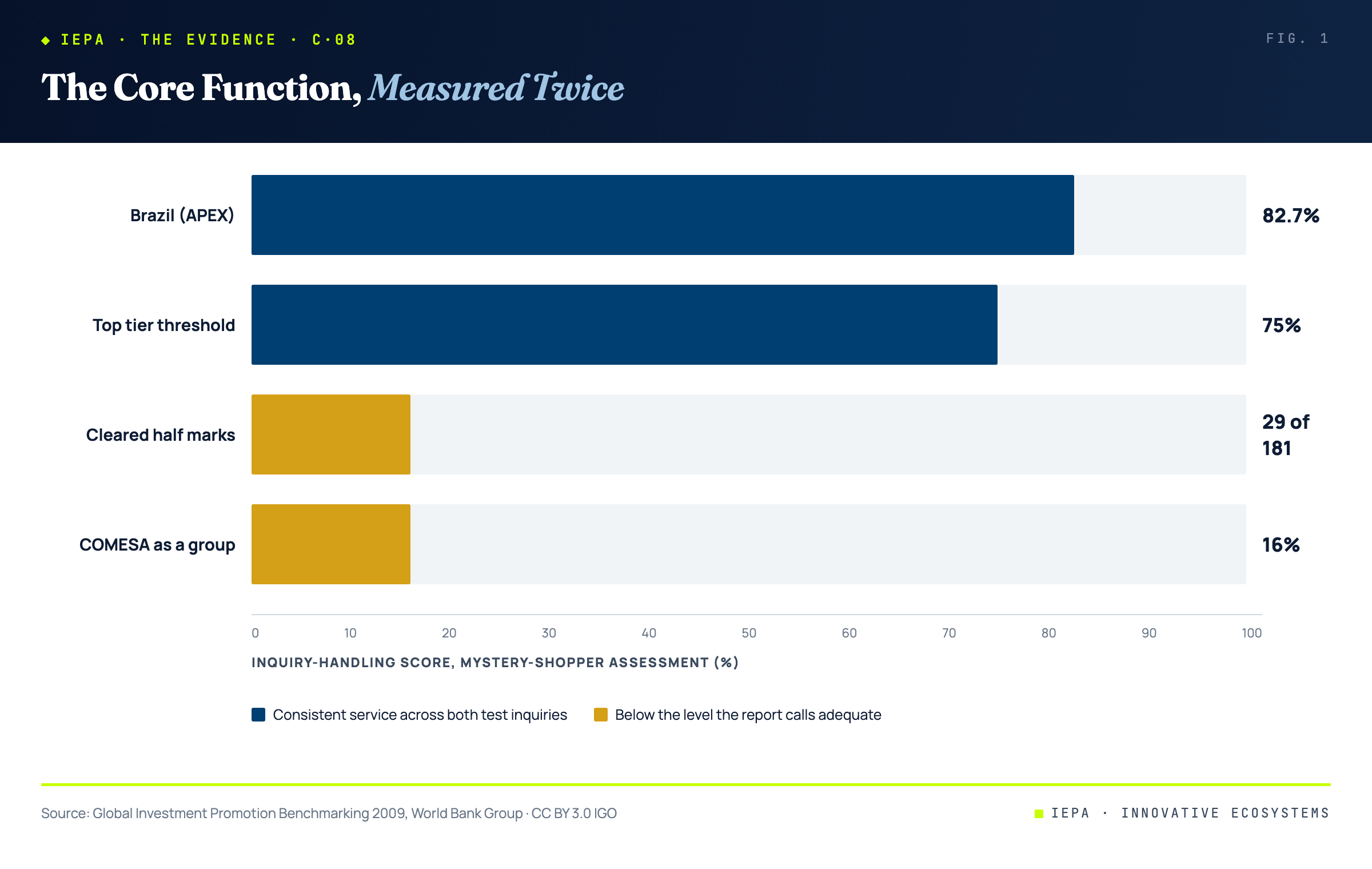
- Only 29 of the assessed agencies scored above 50 percent. The report puts it as 84 percent failing to reach half marks, and concludes that the majority are unable to provide an adequate level of support to companies in the investment process.
- Consistency is what separates the top tier. Agencies above 75 percent delivered high service on both test inquiries. Many mid-tier agencies handled one well and failed to respond usefully to the other.
- Brazil shows the ceiling is reachable. APEX scored 82.7 percent and ranked second worldwide, and would have beaten top-ranked Austria had its second inquiry matched its first.
- This is the one instrument with no fiscal cost. Incentives forgo revenue and zones consume capital. Answering an investor's question well costs staff time, and it is the thing most agencies do worst.
Site selection begins with a shortlist, and the shortlist is made of places the decision maker already knows. Neither consumers nor business managers can monitor every producer or country for opportunities, so decision makers narrow their options to what they are familiar with or what their peers and rivals have chosen. Absent deliberate effort by a country to market itself, company managers have generally failed to add new countries to that shortlist at all. This is the entire premise of investment promotion, and it is a sound one. What follows is what happens when someone tests whether the promotion works.
01The Mystery Shopper Test
Between March and September 2008, the abilities of 181 national investment promotion intermediaries and 32 subnational ones were assessed, in what the report describes as the most comprehensive benchmarking exercise of its kind undertaken to that point. The methodology was peer-reviewed and validated with site selection practitioners, and it replicated actual projects along with the decision criteria and location behaviors of real investors in the early stages of choosing a location.
The core of it was a mystery shopper exercise, run twice against every agency. The first inquiry concerned a beverage manufacturing project with a research and development component. The second concerned a software development center. Each was a plausible, specific project of the kind an agency exists to win, and each was designed to test whether the agency could respond to an information request in a professional and appropriate manner.
The report is explicit about why this matters more than the website assessment that accompanied it. Inquiry handling is harder than maintaining a site, and it is the core of investment promotion, because it involves interacting with the potential investor and is therefore the best opportunity an agency has to influence a company's investment decision. It is the moment the institution exists for.
02Twenty-Nine
The results are stated without hedging. Only 29 agencies scored above 50 percent, meaning that 84 percent of assessed agencies worldwide failed to score at least half marks, indicating that the majority are unable to provide an adequate level of support to companies in the investment process.
It is worth being careful about what that number does and does not say. It is not a measure of whether these agencies attract investment, which depends on far more than correspondence. It is a measure of one specific capability, assessed the same way everywhere, at a single point in time now some years past. But it is a capability the report identifies as the core of the function, and the finding is not marginal underperformance. Five agencies in six could not reach half marks on the thing they exist to do.
03Consistency Is the Whole Skill
The structure underneath the headline is the more useful finding. A clear top tier emerged: agencies scoring 75 percent and higher delivered a consistently high level of service across both inquiries, and those in the 65 to 75 percent band also provided excellent service. What distinguished them was not brilliance on a good day. It was the absence of a bad one.
The failure mode below that tier is specific and recognizable. Many agencies in the average performance band scored well on one project inquiry but failed to respond, or provided only limited information, on the other. The report notes this pattern particularly among agencies in the Eastern Africa region, and suggests they have the potential to upgrade if management makes it a priority to set up internal service standards and information functions, and invests in staff training.
| Performance band | What the assessment found |
|---|---|
| 75% and above | Consistently high service across both inquiries |
| 65% to 75% | Excellent service |
| 41% to 60% (average tier) | Often strong on one inquiry, no response or limited information on the other |
| Below 50% (84% of agencies) | Unable to provide adequate support to investors |
| COMESA as a group | Overall score of 16 percent, very weak tier |
Consistency is the right thing to measure because it is what an investor experiences. A company writing to five countries about one project does not see an agency's average. It sees the reply it got, and the agency that answered a different inquiry well six months ago receives no credit for it. An institution that performs at best practice half the time is, from the perspective of any individual investor, a coin toss.
An investor never sees your average. They see the reply they got. An agency that is excellent half the time is, to the company on the other end, a coin toss.
04Brazil, and What Good Looks Like
The ceiling is not theoretical. Brazil's APEX scored 82.7 percent on inquiry handling and ranked second in the world, and the report notes it would have beaten top-ranked Austria had its performance on the second inquiry matched its performance on the first. Even at the top, consistency was the binding constraint.
What Brazil actually did is unglamorous and entirely copyable. It excelled in the quality of its responses and in customer care after a response was submitted, meaning somebody followed up. Both submissions identified key industry players, set out labor availability and costs, and said where relevant graduates are trained. That is not a marketing campaign. It is a well-researched answer to the questions a company actually asked, delivered by someone who then checked whether it helped.
05The Cheapest Instrument, Least Used
Set this beside the other instruments in this series and the comparison becomes uncomfortable. A tax incentive regime forgoes revenue, and most of what it pays for would have happened anyway. A special economic zone consumes capital and can delay the reforms it substitutes for. A credit guarantee carries contingent liability and has no correct setting.
Answering an investor's question well costs staff time, a service standard, and someone senior enough to insist on both. It forgoes no revenue and builds nothing that has to be maintained for thirty years. On the report's own framing it is the best opportunity an agency has to influence an investment decision. And it is the thing 84 percent of agencies could not do to half marks, in many cases while operating incentive regimes and zone programs that cost orders of magnitude more.
There is a plausible explanation for that inversion, and it is the same one that runs through this series. An incentive can be announced. A zone can be opened. Neither requires the institution to be good at anything on a Tuesday afternoon eighteen months later, which is precisely what answering the second inquiry as well as the first requires. The instruments that get funded are the ones that can be launched. The one that cannot be launched, only sustained, is the one that gets left.
06The Record Since
These figures are from an assessment conducted in 2008 and published in 2009, and the age deserves a direct answer rather than a footnote. The report describes itself as the second in a biennial series and announces a forthcoming edition that would expand the sample to 184 national agencies. Our holdings contain no later edition.
So the honest position is this. The most recent comprehensive, standardized, mystery-shopper measurement of whether investment promotion agencies can answer an investor's question, available to us, is from 2008. Individual agencies have certainly improved since, and some of the specific rankings will have moved. But the capability itself does not appear to have been benchmarked at that scale and with that method again.
That absence is the finding that survives the passage of time. Investment promotion remains a well-funded function across the record through 2026, appearing in country partnership frameworks, private sector diagnostics and regional reviews. The instrument that would tell any of those agencies whether they are good at the thing the report calls the core of investment promotion costs a fraction of what the function spends, and it has apparently not been run at scale in over fifteen years. An agency that wanted to know could find out in a week. Most, on this evidence, have not asked.
07The Builder's Reading
- Mystery shop your own agency. Send two plausible project inquiries from an address nobody recognizes and read what comes back. This is a week's work and it is the only honest assessment available.
- Measure the second inquiry, not the average. Consistency across projects is what defined the top tier and what cost Brazil first place. An average conceals exactly the variance an investor experiences.
- Write the service standard down. The report's recommendation for mid-tier agencies is internal service standards, information functions and staff training. All three are management decisions, not budget lines.
- Answer the question that was asked. Brazil's responses named industry players, labor availability and costs, and where graduates are trained. Generic promotional material is not a response.
- Follow up after replying. Customer care after submission is called out explicitly in the Brazilian case, and it is the step most likely to be skipped when nobody is measuring.
The wider reading is about where an agency's credibility actually comes from. A country that answers a specific question specifically has demonstrated something no brochure can assert: that its institutions function, that somebody there knows the sector, and that a firm which locates there will be able to get an answer when it needs one. That demonstration is available to any agency, in any economy, at effectively no fiscal cost. On this evidence, most were not making it.
Figures are from the 2009 edition of a biennial benchmarking series, covering assessments conducted between March and September 2008 of 181 national and 32 subnational agencies. Inquiry-handling scores derive from two mystery-shopper submissions per agency. The 84 percent figure refers to national agencies failing to reach 50 percent on inquiry handling and should not be confused with a separately reported 84 percent average website content score achieved by OECD high-income agencies. These findings are now some years old and agency performance may have changed; they are presented as a measured baseline of a capability that is rarely measured at all. No IEPA engine outputs are used in this piece.
- Multilateral Investment Guarantee Agency (2009). Global Investment Promotion Benchmarking Report. World Bank Group. CC BY 3.0 IGO.
- Fernandez, M. J., Blanco, A. and Aranda Larrey, Y. (2021). National-Subnational Coordination for Investment Attraction: The Case of Spain. World Bank. CC BY 3.0 IGO.
- Innovative EcoSystems. Seventy Percent Would Have Come Anyway. 2026.
- Innovative EcoSystems. Everyone Has a Zone. 2026.
- Innovative EcoSystems. The Accelerator, Not the Engine. 2026.
The Threshold Nobody Budgets For
Foreign investment raises growth only above a minimum stock of human capital. Between 23 and 47 of the 69 countries studied sat below the line.
→Explore the IEPA
Six zones, every market this research is scored from.
→Open the Atlas
The live global registry this research is drawn from.
→