The Threshold Nobody Budgets For
Foreign investment raises growth only above a minimum stock of human capital. Depending on how you specify the model, between 23 and 47 of the 69 countries studied sat below the line.
Every argument in this series about incentives, zones and promotion agencies assumes foreign investment is worth attracting. That assumption is not wrong, but it is conditional in a way the policy conversation rarely reflects. The condition was identified in 1998, refined since, and it is the single most consequential finding about FDI that does not appear in the strategies built to attract it.
- FDI outperforms domestic investment, but only above a threshold. The 1998 study across 69 developing economies found FDI contributes to growth only where sufficient absorptive capability for advanced technology already exists.
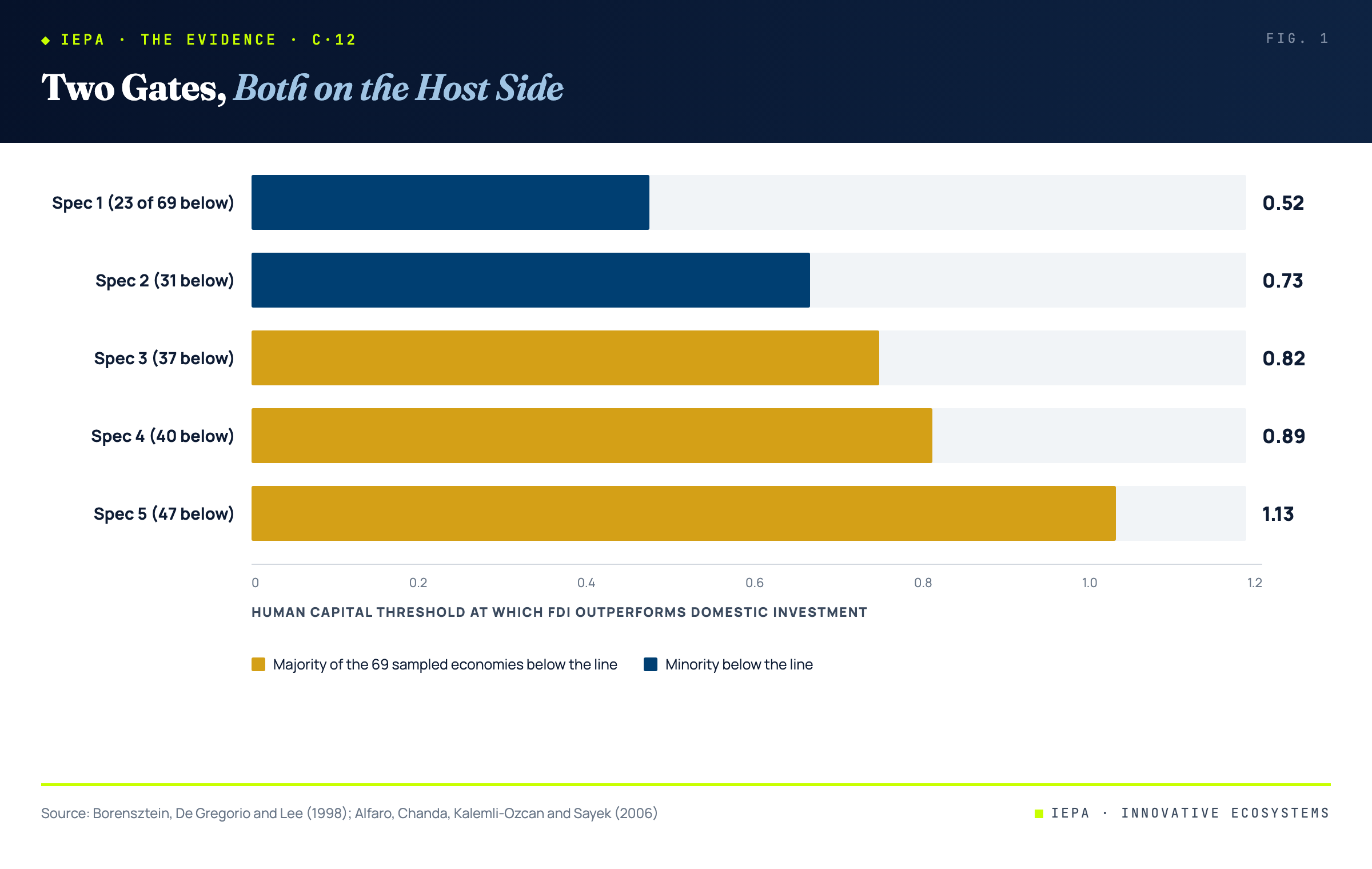
- The threshold is measurable and a lot of countries were under it. Depending on specification the education threshold ranged from 0.52 to 1.13. Between 46 and 22 of the 69 countries met it, leaving 23 to 47 below.
- Capital and capability are complements, not substitutes. The effect is interactive: the contribution of FDI to growth is enhanced by its interaction with the level of human capital, which means more of one does not compensate for less of the other.
- A second condition may operate on the financial side, and it is contested. Some work finds countries with well-developed financial markets gain significantly more from FDI. A later meta-analysis finds the opposite sign. We treat it as unsettled.
Read almost any regional investment strategy and the logic runs in one direction: attract capital, and capability follows. Foreign firms bring technology, local firms learn it, workers acquire skills, and the economy climbs. The mechanism is real and it is well documented. What the strategies almost never state is the finding that arrived with it, which runs the other way: the learning only happens if the capability is already there to receive it. Below a certain level, the capital arrives and the transfer does not.
01The 1998 Result
Using data on foreign investment flowing from industrial countries to 69 developing economies over two decades, the study tested whether FDI contributes more to growth than domestic investment does. It found that it does, describing foreign investment as an important vehicle for the transfer of technology and one contributing relatively more to growth than domestic investment. That part is the case for investment promotion, stated by the evidence.
The qualification arrives in the same abstract. The higher productivity of FDI holds only when the host country has a minimum threshold stock of human capital. FDI contributes to economic growth, in the authors' words, only when a sufficient absorptive capability of the advanced technologies is available in the host economy.
FDI is more productive than domestic investment only above a threshold. Below it, the comparative advantage of foreign capital disappears.
The structure of the finding matters as much as the finding. The relationship is not additive, where capital and capability each contribute their own increment. It is interactive: the contribution of FDI to growth is enhanced by its interaction with the level of human capital in the host country. Two inputs that multiply rather than add cannot substitute for one another, which means no volume of inward investment compensates for a workforce that cannot absorb it.
02Where the Line Falls
The study does not leave the threshold abstract. It reports the education threshold across a series of specifications, alongside how many of the 69 countries met each one. The complement is the number that did not.
| Specification | Education threshold | Countries meeting it | Countries below |
|---|---|---|---|
| 1 | 0.52 | 46 of 69 | 23 |
| 2 | 0.73 | 38 of 69 | 31 |
| 3 | 0.82 | 32 of 69 | 37 |
| 4 | 0.89 | 29 of 69 | 40 |
| 5 | 1.13 | 22 of 69 | 47 |
Take the range at its most and least demanding. On the most demanding specification the threshold reaches 1.13 years and only 22 economies clear it, leaving 47 below, just over two thirds of the sample. On the most permissive the threshold falls to 0.52 and 46 clear it, leaving 23 below, exactly one third. Every one of those economies was, during the period studied, competing to attract foreign investment, and a substantial number of them were doing so with incentive regimes of the kind examined earlier in this series.
03The Second Gate
Human capital is not the only condition. A parallel literature examines the financial side and reaches a structurally identical conclusion: the ability to take advantage of FDI externalities may be limited by local conditions such as the development of local financial markets or the educational level of the country, which the literature groups under absorptive capacity. On that reading, only countries with well-developed financial markets gain significantly from FDI in terms of their growth rates.
The mechanism is intuitive once stated. A domestic supplier that spots an opportunity to serve a newly arrived multinational needs to finance the equipment, the certification and the working capital to do it. Where credit is unavailable, the opportunity is visible and unreachable, and the multinational imports the input instead.
That reading is plausible and it is not settled. A later meta-analysis pooling thousands of estimates finds the opposite sign, reporting that greater spillovers are received by countries with underdeveloped financial systems, on the argument that foreign investment can itself relieve the credit constraint and that supplier status to a multinational is worth more where credit is scarce. Both mechanisms are real and they point in opposite directions. We treat the human capital threshold as established and the financial condition as contested, and the contest is examined in the next piece in this series.
04What This Does to the Rest of the Series
Set this beside the instruments examined earlier and an uncomfortable ordering appears. An incentive regime lowers the price of investing. A zone improves the conditions inside a perimeter. A promotion agency makes a location visible. All three operate on whether capital arrives. None operates on whether the economy can convert it once it does.
That is a coherent division of labour if somebody else is working on the conversion side. Frequently nobody is, because absorptive capacity is a decade-long programme in schooling, technical training and financial sector development, and it produces no announcement. The instruments that get funded are the ones that operate on arrival, and arrival is the half of the equation the evidence says matters less.
It also reframes what a low conversion rate means. An economy that attracts investment and sees little growth from it is not necessarily attracting the wrong investment or negotiating badly. It may be sitting below a threshold identified nearly thirty years ago, in which case the response is not a better incentive package. It is the unglamorous work the incentive package was funded instead of.
05The Record Since
The 1998 finding has been extended rather than overturned. The later work on financial markets treats the human capital threshold as established and adds a second condition rather than disputing the first. Both are now standard in the academic literature on absorptive capacity, and this publication has previously found the same pattern in its own index: splitting economies by the strength of their foundations, foreign investment adds a few points of prosperity on a strong base and close to nothing on a weak one.
What has not changed in the same period is the shape of investment strategy. The instruments documented across this series, from incentive regimes to zones to promotion agencies, remain overwhelmingly concentrated on attraction. The threshold literature is nearly three decades old, is not contested, and is cited in the strategies it should be reorganizing. It is a rare case of evidence being widely known, widely referenced, and structurally ignored.
06The Builder's Reading
- Establish where you sit before setting an attraction target. The threshold is about the host economy, and an economy below it should expect foreign investment to perform no better than domestic investment.
- Budget the conversion side explicitly. Technical schooling, vocational training and financial deepening are the inputs the evidence says gate the return. They are also the ones with no ribbon.
- Treat capital and capability as multiplicative. Doubling inflows against a thin capability base does not double the benefit. The interaction term is the whole finding.
- Check whether local suppliers can finance the opportunity. A spillover requires a domestic firm able to raise working capital to serve the entrant. Where it cannot, the input is imported and the linkage never forms.
- Interrogate a poor conversion rate before renegotiating the deal. Low returns on inward investment often indicate a threshold problem, not a bargaining problem, and the two have opposite remedies.
The broader reading is about which half of a strategy gets attention. Attraction is legible, competitive and immediate: you either won the plant or you did not. Absorption is diffuse, slow and impossible to attribute to any single official. The evidence has been clear for nearly thirty years that the second half determines the value of the first, and the allocation of effort has not moved to match. That is not an argument against attracting investment. It is an argument that the attraction is the easier half, and that doing it well while neglecting the other produces exactly the outcome the data has been describing since 1998.
The threshold figures are from a cross-country regression framework covering FDI flows from industrial countries to 69 developing economies over two decades to the mid-1990s. Education thresholds are reported across five specifications and are expressed in the study's own units of secondary schooling attainment. The study reports the number of countries satisfying each threshold in 1980; the count below each is the complement out of 69 and is derived here, not quoted. The financial-market condition is drawn from the 2006 NBER working paper by the same authors as the frequently cited 2004 article; only the working paper has been read here and only it is cited. No IEPA engine outputs are used in this piece.
- Borensztein, E., De Gregorio, J. and Lee, J-W. (1998). How Does Foreign Direct Investment Affect Economic Growth? Journal of International Economics, 45(1), 115–135.
- Alfaro, L., Chanda, A., Kalemli-Ozcan, S. and Sayek, S. (2006). How Does Foreign Direct Investment Promote Economic Growth? Exploring the Effects of Financial Markets on Linkages. NBER Working Paper 12522.
- Innovative EcoSystems. The Accelerator, Not the Engine. 2026.
- Innovative EcoSystems. Seventy Percent Would Have Come Anyway. 2026.
- Innovative EcoSystems. Everyone Has a Zone. 2026.
Spillovers Travel Down, Not Across
Benefits reach suppliers, not competitors. And when 3,626 published estimates were corrected for publication bias, the average effect fell fivefold.
→Explore the IEPA
Six zones, every market this research is scored from.
→Open the Atlas
The live global registry this research is drawn from.
→