Everyone Has a Zone
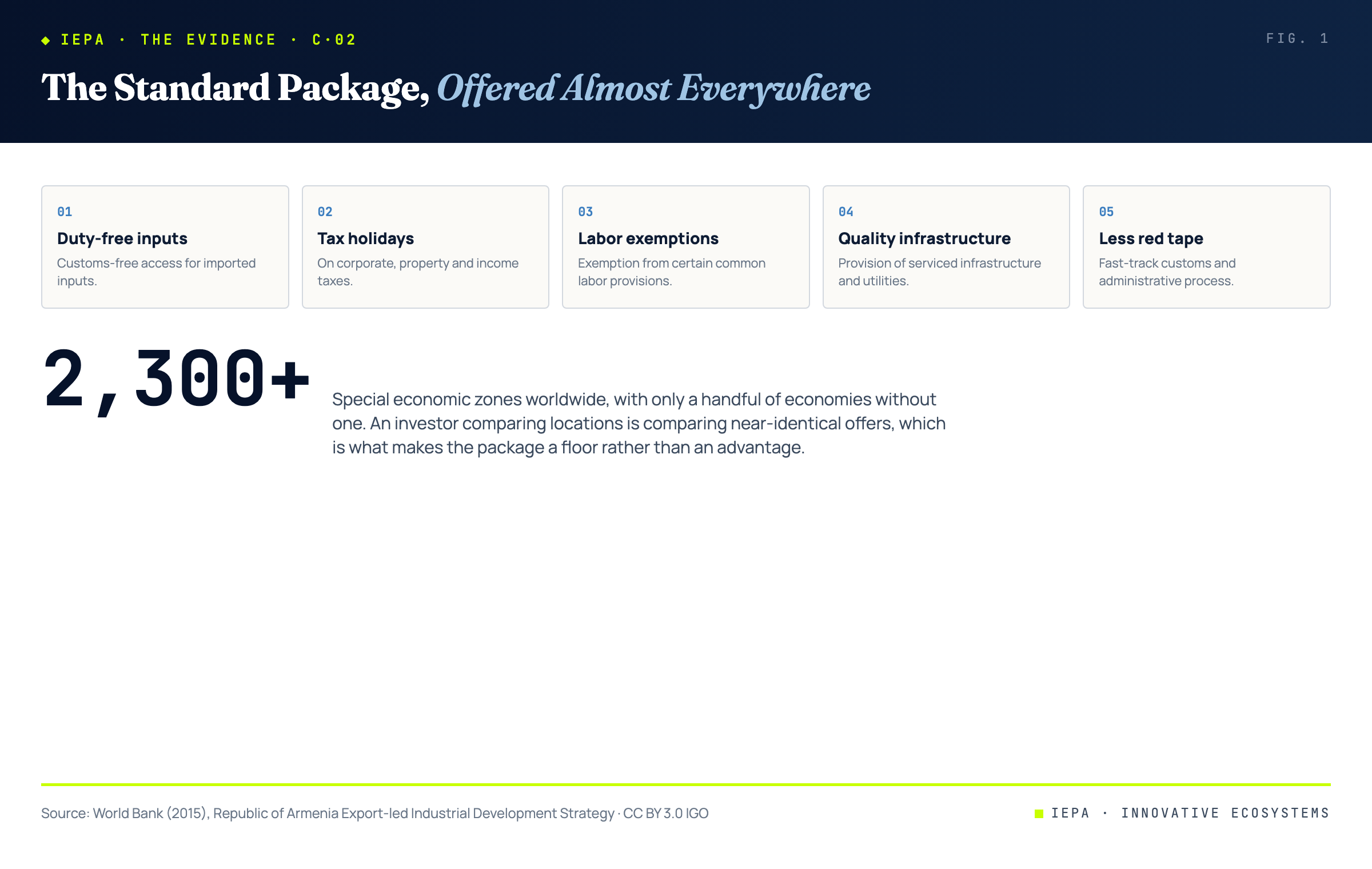
There are more than 2,300 special economic zones on earth and only a handful of economies without one. An instrument that everybody has is not an advantage. It is a floor.
The special economic zone is the most visible instrument in regional economic strategy: a defined perimeter inside which the rules are better than the rules outside it. It is also, at this point, close to universal. That universality is the first thing worth reckoning with, and the second is what a zone quietly says about the territory surrounding it.
- Over 2,300 zones globally, and almost no economy without one. Whatever a zone once conferred, it cannot be differentiation when the entire field has one.
- A zone is a second-best solution, and the record says so plainly. Country analysis describes zones as enclaves that create a dual economy and delay country-wide reform. The zone is not a substitute for the reform. It is a reason to postpone it.
- Some zones are legally designed to prevent the linkages that justify them. Jamaica's Export Free Zone Act contained arrangements that discourage or prevent strong links between zone firms and the rest of the economy. The spillover was legislated out.
- The failure mode is capture, not construction. Where zone success has been assessed, it turns on getting the institutional framework right and preventing business capture of policymaking. Neither is a real-estate problem.
A special economic zone is an admission. It says that somewhere inside this border, the state can deliver reliable customs, competitive tax treatment, functioning infrastructure and a tolerable amount of paperwork, and that outside that border it cannot. Drawn narrowly, that is a pragmatic sequencing decision: prove the model in one place, extend it later. Drawn otherwise, it is a permanent arrangement in which a small enclave receives good governance and the rest of the economy receives a plan to receive it eventually. The evidence on which of those two a zone becomes is not encouraging, and the first clue is how many of them exist.
01The Instrument Everybody Has
The count is the least ambiguous fact in this literature. There are over 2,300 special economic zones globally, and only a handful of economies are without one. Whatever competitive edge a zone conferred when they were rare, arithmetic has since removed it. A location that offers customs-free access to imported inputs, tax holidays on corporate and property taxes, exemption from certain labor provisions, quality infrastructure and fast-track customs is offering what almost every competing location already offers.
This is the same structure as the incentive problem treated elsewhere in this series, one level up. An incentive competes on price against rivals who can match the price instantly. A zone competes on a package of conditions against rivals who have already assembled the same package. In both cases the instrument is real, the cost is real, and the differentiation evaporates the moment everyone adopts it, which they have.
02The Second-Best Problem
The more serious objection is not that zones are common. It is what a zone does to the reform agenda outside its fence. Country analysis of the question is unusually direct: a special economic zone can encourage diversification through foreign investment and linkages with domestic firms, but it may be a second-best solution because of its enclave nature, which often creates a dual economy and delays country-wide reform.
Read that sequence carefully, because the causal claim is stronger than it first appears. The zone does not merely fail to spread good governance outward. It reduces the pressure to spread it, by giving the constituency that most wanted reform, the exporters and foreign investors with the loudest voice and the most mobile capital, a private arrangement that solves their problem. Once the firms who would have lobbied for national customs reform have their own fast-track lane, national customs reform loses its most effective advocates. The enclave is not a staging post toward the general case. It is frequently a substitute for it.
A zone gives the firms who would have demanded reform a private exemption from needing it. The constituency for change is the first thing the fence encloses.
03Linkages Legislated Away
The justification for a zone almost always rests on linkages. Foreign firms locate inside, domestic suppliers grow up around them, capability transfers outward through the supply chain, and the enclave dissolves into the economy that hosts it. That is the theory, and it is a reasonable one; the wider evidence on foreign investment says spillovers do travel through supplier relationships, a point taken up elsewhere in this series.
Which makes Jamaica's case worth stating plainly. Its country economic memorandum records that tax incentives under the Export Free Zone Act sat alongside other arrangements that discourage or prevent strong links between firms located in these zones and other sectors or enterprises. The instrument whose entire developmental rationale is linkage contained provisions working against linkage. The same analysis notes enclave formation as a response to crime rates and to fiscal incentives favoring large-scale, capital-intensive operations, which is to say the enclave was not an accident of geography but a product of how the incentives were written.
This is the difference between a zone that is a bridge and a zone that is a moat. Nothing about a perimeter determines which one it becomes. The determinant is whether the rules inside were drafted to connect the zone to the domestic economy or to insulate it from the domestic economy's problems. It is entirely possible, and on this record not unusual, to build the second while describing it as the first.
04What Actually Decides It
The record does not say zones cannot work. It says the variables that decide are not the ones that get budgeted. Where the question has been assessed directly, success is described as depending on setting the institutional framework right and on avoiding a situation where businessmen capture government policymaking. Both are governance conditions. Neither is land, serviced plots, or a ribbon.
That capture risk deserves more attention than it gets. A zone concentrates discretionary benefit, a defined set of firms, and a dedicated authority in one place, which is an efficient arrangement for delivering services and an efficient arrangement for regulatory capture. The same analysis flags significant risks in managing estate development, promotion and services, the ordinary difficulty of running what is, operationally, a state-backed property business. A government that would not choose to become a landlord and a utility often finds it has become both.
The honest summary of the comparative record, in the words of one country strategy that surveyed it, is that zone experiences had opposite outcomes and the task is to understand the factors behind that divergence before applying anything locally. That is a more useful starting point than the usual one. The question is not whether zones work. It is which conditions separated the ones that did from the ones that did not, and whether your economy has those conditions or is hoping the zone will supply them.
05The Record Since
The findings above date from 2010 and 2011, and the fair question is whether anything since has overturned them. In our reading of the institutional record, nothing has, and the more interesting observation is what is missing. Zones appear continuously in country analysis from 2000 to 2026, but recent appearances are operational rather than evaluative: how a zone is administered, which barriers slow investors inside it, how it fits a partnership framework. The enclave and dual-economy findings have not been revisited so much as left standing while construction continued.
Country work as recent as 2022 still reaches back to a dedicated 2011 comparative study of zone performance in Africa when it needs evidence on whether zones deliver. That is a reasonable thing to cite. It is also a signal: more than a decade on, that study is still the reference, because the comparative evaluation has not been repeated at the same depth. The instrument kept spreading. The measurement did not keep pace.
06The Builder's Reading
If a region is considering a zone, or already operates one, the useful questions are narrow and answerable.
- What does the zone offer that competing locations do not? With 2,300 zones in the field, the standard package is a baseline. If the answer is the standard package, the zone is not a strategy.
- Which reform is the zone postponing? Name it explicitly. If national customs, tax administration or land access would otherwise be on the agenda, the zone has removed the pressure and someone should be tracking that.
- Read the enabling act for anti-linkage provisions. Rules on domestic sales, local sourcing and movement of goods can prevent the spillovers the zone exists to produce. Jamaica's did.
- Who is inside the fence, and are they footloose? A zone populated by firms that came for the domestic market or a local resource is subsidizing investment that had nowhere else to go.
- Where does authority sit, and what stops capture? A concentrated benefit with a dedicated authority is the standing precondition for policy capture. The institutional answer has to exist before the tenants arrive.
The deeper reading is about what a zone signals. To an investor comparing locations, a well-run zone says the state can deliver reliable conditions when it chooses to. That is a genuine and valuable signal. But it carries an implication the brochure does not mention: that beyond the perimeter, those conditions are not guaranteed. An economy whose good governance is available only inside a fence has told a foreign investor exactly how far the good governance extends. The most successful zones are the ones that eventually become unnecessary, because the conditions inside were exported outward rather than defended inward. Very few are built with that ending in mind.
The global zone count and the standard benefit package are as reported in Armenia's export-led industrial development strategy, which surveyed comparative zone experience. The second-best characterization, the dual-economy and delayed-reform findings, and the capture and estate-management risks are from Mauritania's country economic memorandum. The anti-linkage provisions are as recorded in Jamaica's country economic memorandum. These are country analyses rather than a systematic global evaluation of zone performance, and are presented as such. No IEPA engine outputs are used in this piece.
- World Bank (2015). Republic of Armenia Export-led Industrial Development Strategy. CC BY 3.0 IGO.
- World Bank (2010). Mauritania: Policy Options to Enhance Private Sector Development, Country Economic Memorandum. CC BY 3.0 IGO.
- World Bank (2011). Jamaica: Country Economic Memorandum, Unlocking Growth. CC BY 3.0 IGO.
- Innovative EcoSystems. Seventy Percent Would Have Come Anyway. 2026.
- Innovative EcoSystems. The Accelerator, Not the Engine. 2026.
Evidence of Results
Fourteen innovation agencies studied by the institution that funds them. Under a heading marked Impact Evaluations, most of what appears is a count of beneficiaries.
→Explore the IEPA
Six zones, every market this research is scored from.
→Open the Atlas
The live global registry this research is drawn from.
→