The Park Is Not the Point
A government built technology zones to put companies next to researchers. Years later, a survey of the tenants found that four percent of them had started collaborating with researchers.
Co-location is the most intuitive idea in innovation policy. Put firms beside universities, and knowledge will move between them. It is intuitive enough that it rarely gets tested, which makes the one well-documented case where somebody did test it unusually valuable. The result was four percent.
- The policy worked exactly as designed and failed anyway. Firms were induced onto university campuses by conditioning R&D tax breaks on locating in technology development zones. They located. They did not collaborate.
- Four percent of tenants began collaborating with researchers after moving into the zones, according to a survey conducted years after the program started.
- The country ended up with roughly six times the science park supply of the United States, normalized by researchers or R&D investment, which suggests the supply was well past what the research base could use.
- The conceptual error is named in the source. High-level impacts are third-order effects. Assuming first-order effects will automatically become second- and third-order ones is described as a common mistake in policy making.
Every science park rests on a chain of assumptions. Build the space, and firms will occupy it. Firms occupying it will meet the researchers next door. Those meetings will become collaborations, the collaborations will become commercialized research, and the commercialized research will show up as competitiveness. Each link is plausible. The chain is only as strong as its weakest one, and almost nobody checks which link that is, because checking requires surveying tenants years later about something the program's own reporting never asks.
01What Country Beta Did
In the early 2000s a country, identified in the source only as country Beta, set out to increase collaboration between research institutions and industry. Its chosen mechanism was location: it would encourage companies to site themselves on university campuses. To make that happen it used the strongest instrument available, conditioning access to tax breaks on R&D expenditure upon the firm locating inside a technology development zone.
The instrument worked. Firms moved. Demand for space inside the zones rose to the point that physical space became scarce and rents increased, and the government responded by subsidizing the construction and expansion of more zones. Read as a program dashboard, this is a success story at every stage: uptake strong, occupancy high, expansion required to meet demand. Every first-order indicator pointed upward.
02Four Percent
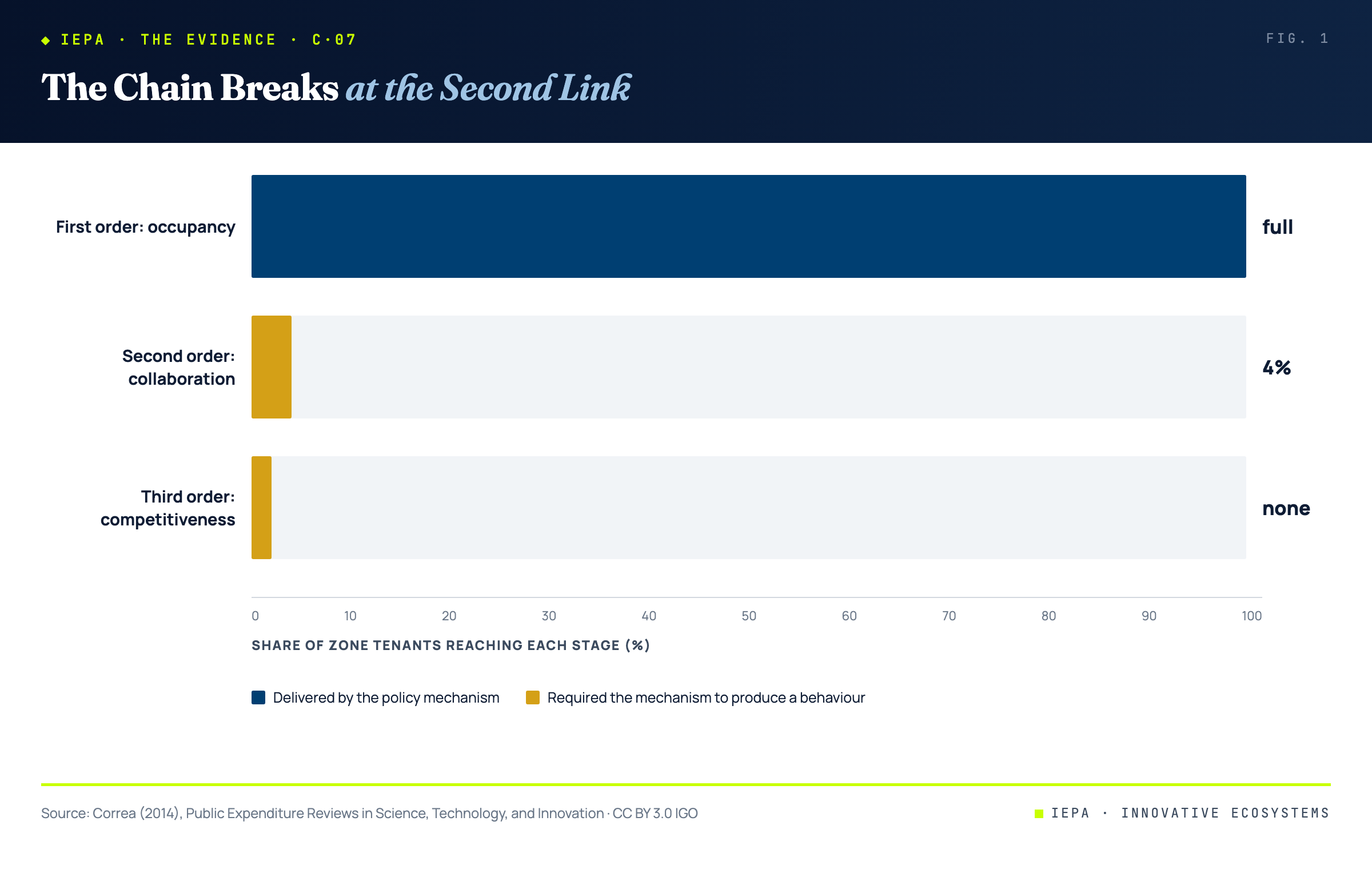
A survey of tenants, implemented years after the start of the program, showed that only 4 percent of tenants had started collaborating with researchers after locating in the technology development zones.
The number is worth sitting with, because it does not describe a program that underperformed. It describes a program that achieved its mechanism completely and its purpose almost not at all. The firms were exactly where the policy wanted them. Ninety-six percent of them carried on as though the university next door were not there.
The reason is visible in the instrument. The tax break was conditioned on location, so the firms it attracted were firms for whom the tax break was worth relocating for. Nothing in the design selected for firms with a research problem a nearby university could help solve. The policy recruited tax-motivated tenants and then expected research-motivated behavior, and it got what it selected for. Proximity was necessary for collaboration and nowhere near sufficient, and the mechanism that produced the proximity actively worked against the sufficiency.
The zones selected for firms that wanted a tax break, then expected behavior from firms that wanted a research partner. Policy gets what it selects for.
03Six Times the United States
The second finding compounds the first. The combination of those measures, the conditional tax break and the subsidized construction, produced a supply of science parks in the country which, normalized by the number of researchers or by R&D investment, was about six times larger than that of the United States.
That ratio is the clearest available evidence that the constraint was misdiagnosed. If a country has six times the park capacity per researcher of the United States, then park capacity is not what is limiting its research-industry collaboration. Something else is: the incentives inside universities, the absorptive capacity of the firms, the availability of people who can work across both cultures, the intellectual property arrangements. Whatever it is, more square meters cannot reach it, and the program kept building more square meters because occupancy was high and occupancy was the number being watched.
04Third-Order Effects
The source generalizes the failure precisely, and the framing is the most portable thing in this piece. Decision making about public policy often assumes outputs and results will be achieved automatically once the policy input, meaning public funds, is made available. But high-level developmental impacts such as competitiveness are third-order effects: they are the indirect consequence of outputs, which are first-order effects, and of the outcomes those outputs generate under specific circumstances.
Assuming that first-order effects will generate second-order effects, and that those will in turn be transformed into the desired high-level impact, is described in the source as a common mistake in policy making. Omitting the conditions under which public expenditure will reach a desired outcome is named as a major cause of the misuse of public funds.
Read that against how science parks are usually justified and the gap is obvious. The business case states the third-order effect, competitiveness or cluster formation. The budget buys the first-order effect, buildings and occupancy. The second order, the actual collaboration, is where the mechanism has to work, and it is the one stage nobody funds, measures or designs for. Country Beta's four percent is what the middle of that chain looks like when it is left to happen on its own.
05The Record Since
Country Beta's tenant survey was reported in 2014, and the reason it still carries weight is that so little has been done since to test the same question. Science and technology parks run continuously through the institutional record from the late 1990s to 2026. What appears alongside them, with rare exceptions, is description rather than measurement: how many exist, what they cost, which ministries operate them.
The survey that produced the four percent figure was unusual not because it was sophisticated, but because somebody went back and asked the occupants a direct question years after the ribbon was cut. That is not an expensive research design. Its rarity, relative to the volume of park construction over the same period, is the strongest available evidence that the second-order effect this instrument exists to produce is still, as a general matter, assumed rather than observed.
06The Builder's Reading
This is not an argument that science parks cannot work. It is an argument that the thing they are built to produce is a behavior, not a location, and that behaviors need to be designed for explicitly.
- State the second-order effect and how it will be measured. Occupancy is a first-order number. Collaborations begun, joint projects funded, researchers seconded into firms. If none of those is tracked, the program cannot detect its own failure.
- Check what your incentive selects for. A benefit conditioned on location recruits firms that want the benefit. If you want collaborating firms, condition on collaboration.
- Normalize supply against the research base. Six times the US park capacity per researcher was the signal that capacity had stopped being the constraint. That ratio is calculable before building more.
- Name the conditions under which the chain completes. The source calls omitting them a major cause of the misuse of public funds. Write them down and check whether they hold locally.
- Survey the tenants. Country Beta only learned this because someone asked the occupants years later. That survey is cheap relative to the construction it might have prevented.
The broader reading connects this piece to the rest of the series. Special economic zones are the same instinct at economic scale, and the finding there was that a zone can be legislated in a way that prevents the linkages justifying it. Incubators are the same instinct at building scale, and the finding there was that a count can quadruple while function does not move. In all three the physical thing gets built because the physical thing is what a budget can buy and a count can verify. The relationship it was supposed to produce is harder to fund, harder to observe, and the only part that ever mattered.
The case is presented in the source as country Beta, one of two real but anonymized national case studies. The 4 percent tenant figure and the six-times-United-States park supply comparison are as reported there. A separate illustrative table in the same document, covering a hypothetical country Alfa, is not used here: it is a worked example rather than observed national expenditure, and is noted only to mark the distinction. No IEPA engine outputs are used in this piece.
- Correa, P. (2014). Public Expenditure Reviews in Science, Technology, and Innovation: A Guidance Note. World Bank. CC BY 3.0 IGO.
- Innovative EcoSystems. Everyone Has a Zone. 2026.
- Innovative EcoSystems. Counted, Not Working. 2026.
- Innovative EcoSystems. Innovation Capacity Is Not Innovation Output. 2026.