Counted, Not Working
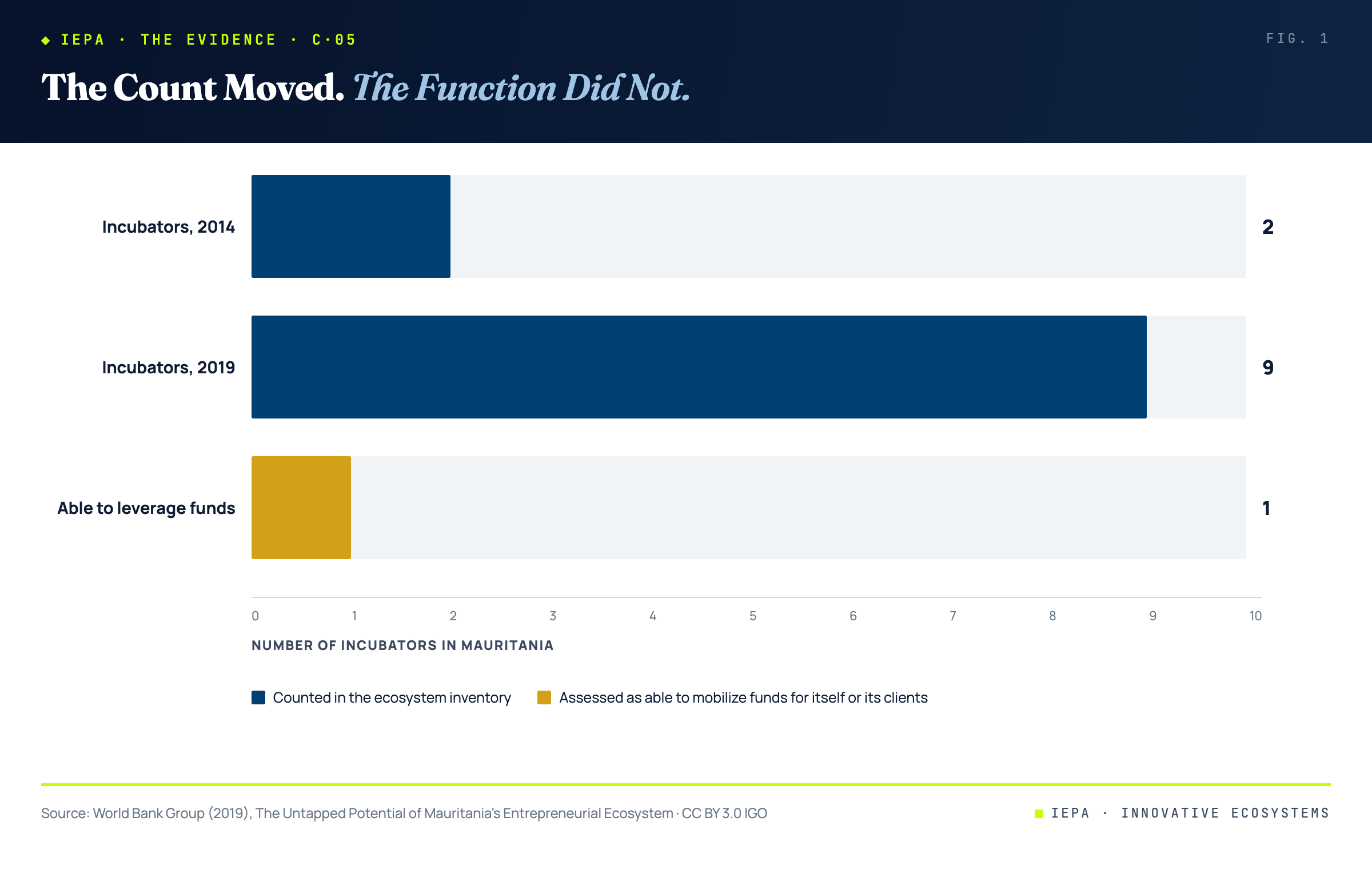
Mauritania's incubators went from two to nine in five years. Its own diagnostic found exactly one able to raise money for the firms inside it. The count quadrupled. The function did not move.
Ecosystem strength is almost always reported as an inventory. So many incubators, so many accelerators, so many co-working spaces, so many hubs. The inventory is easy to compile and easy to grow, which is most of why it is the number that gets reported. The question nobody asks of the inventory is whether the organizations in it do the thing their category name implies.
- Mauritania's incubator count rose from two in 2014 to nine in 2019. Its diagnostic recorded that incubators' ability to mobilize funds or facilitate clients' access to finance was very limited, with a single incubator capable of leveraging funds.
- Chile focused on the building rather than the process. Attention went to incubators based at universities rather than the broader incubation process around the entrepreneur, which the analysis gives as the explanation for weak impact to date.
- Category names are not capability claims. An organization calling itself an incubator has told you its category, not whether it can raise capital, place a founder, or move a firm's revenue.
- The counting failure is why density signals need grading. A count that treats one functioning organization and eight nameplates as nine is not measuring the ecosystem. It is measuring the register.
There is a specific and common way for ecosystem support to fail that leaves no trace in any of the usual indicators. The organizations get founded. The ribbon gets cut. The count in the annual report goes up, and every subsequent strategy document cites it as evidence of momentum. What does not happen is the thing the organizations were founded to do, and because nobody measures that separately, the failure is invisible in exactly the numbers designed to detect success.
01Two to Nine
Mauritania is the cleanest illustration because both halves of the picture appear in the same document. Between 2014 and 2019, the number of incubators in the country rose from two to nine. On any density measure, that is a 4.5x expansion of entrepreneurial support infrastructure in five years, and it is the kind of number that appears in a national strategy as proof that the ecosystem is deepening.
The same diagnostic, assessing what those organizations could actually do, found that beyond training programs and mentoring, incubators' ability to mobilize funds or facilitate their clients' access to finance was very limited. On its assessment there was only one incubator capable of leveraging funds, either for itself or for the businesses it supported.
Set those two facts beside each other and the density measure inverts in meaning. Nine organizations existed. One could perform the function that distinguishes an incubator from a room with desks in it. A count reports a 4.5x improvement. A capability assessment reports something much closer to flat.
02Chile, a Decade Earlier
This is not a small-economy problem or a recent one. A decade before the Mauritanian assessment, analysis of Chile's technology transfer and commercialization landscape reached a structurally identical conclusion by a different route. There, attention had been focused on incubators based at universities rather than on the broader incubation process that revolves around the entrepreneur and the business idea, and the analysis offers that focus as the explanation for the weak impact to date.
The phrasing is worth reading closely, because it identifies the substitution precisely. Incubation is a process: finding a founder, testing an idea, connecting it to capital and customers, and staying with it through the part where it nearly fails. An incubator is a place. The two are related but they are not the same thing, and it is entirely possible to fund the place while never assembling the process. Chile funded places attached to universities. The process, which revolves around the entrepreneur rather than the institution, was not what got built.
Incubation is a process. An incubator is a place. Funding the second and reporting it as the first is the most common substitution in ecosystem policy.
03Why the Count Wins
The count wins because it is available. An incubator either exists or it does not, and the number can be assembled from a registry in an afternoon. Whether it can raise capital for its cohort requires knowing what its cohort raised, from whom, and whether they would have raised it anyway, which is a research exercise nobody has commissioned.
It also wins because it is controllable. A ministry can cause an incubator to exist. It cannot straightforwardly cause an incubator to become good at placing firms with investors, because that depends on the staff's networks, the depth of the local capital market, and a track record that takes years to accumulate. Given a target expressed as a count, the count is what an administrator can deliver, and it will be delivered.
Mauritania's own analysis reaches for the honest formulation. If entrepreneurs are not likely to succeed, or do not have the necessary financial resources, then incubators cannot become profitable, and the recommendation that follows is that incubators would do well to consider themselves startups. That is a sharper diagnosis than it first appears. It says the organizations in the count are themselves early-stage ventures with unproven models, most of which will not work, and that treating their existence as a settled asset misreads what they are.
04What This Means for Density
Any index or registry that scores an ecosystem partly on the density of support organizations inherits this problem directly. If nine organizations and one functioning organization produce the same reading, the signal is measuring registration rather than capability, and it will rate a country that opened seven nameplates above one that has a single institution actually placing firms with capital.
The honest response is not to discard the density signal, which does carry information, but to grade it. Verified operating status is a different fact from registered existence. Whether an organization has moved capital, and how much, is a different fact again, and it is the one that separates the category from the function. Where those facts cannot be established, the correct treatment is to label the confidence low rather than to let a count stand as a capability claim.
05The Record Since
The two cases here are separated by a decade and by a continent, and that separation is the point. Chile in 2009 and Mauritania in 2019 were not comparing notes. Two country teams, working independently on different economies at different income levels, arrived at the same structural observation: that the organizations existed and the function did not follow. A finding that reappears without being sought is more durable than one produced by a study designed to find it.
Incubators continue to appear across the record through 2026, and the pattern of appearance is consistent. They are counted in inventories, named in strategies, and funded in partnership frameworks. What is largely absent, in our holdings, is the follow-up assessment of the kind Mauritania performed, asking not how many exist but how many can do the thing. That asymmetry between how often the count is reported and how rarely the function is tested is the mechanism by which the substitution survives.
06The Builder's Reading
- Ask what the organization has moved, not what it is called. Capital raised by its firms, placements made, revenue changed. The category name asserts none of these.
- Fund the process, not the premises. Chile's finding is that attention on university-based buildings rather than the incubation process around the entrepreneur is what explains weak impact.
- Treat support organizations as ventures. Mauritania's recommendation, that incubators consider themselves startups, implies most will not work and the portfolio should be managed accordingly.
- Grade density, do not just count it. Registered, verified operating, and demonstrably moving capital are three different populations. Reporting them as one number destroys the distinction that matters.
- Be suspicious of your own growth number. A count that quadrupled in five years is the specific pattern in which this failure hides, because it looks exactly like success.
The deeper point applies well beyond incubators. Any ecosystem asset counted by category rather than assessed by function invites the same substitution, and the substitution is not usually cynical. It is what happens when a target is set in the only unit that is easy to measure, and everyone involved responds rationally to the target they were given. The correction is not more scrutiny of the organizations. It is a target expressed in something they cannot satisfy by existing.
Mauritania's incubator counts and the capability assessment are as recorded in its 2019 ecosystem diagnostic. The Chilean finding is from 2009 analysis of technology transfer and commercialization. Both are country analyses rather than systematic multi-country evaluations of incubator performance, and are presented as illustrations of a pattern rather than as a measured global effect. No IEPA engine outputs are used in this piece.
- World Bank Group (2019). The Untapped Potential of Mauritania's Entrepreneurial Ecosystem. CC BY 3.0 IGO.
- World Bank (2009). Chile: Fostering Technology Transfer and Commercialization. CC BY 3.0 IGO.
- Innovative EcoSystems. The Entrepreneurship Capacity Gap. 2026.
- Innovative EcoSystems. Why We Built Six Zones Instead of One Number. 2026.
Ask, or Measure
There are two ways to know what would have happened otherwise. One study did both on the same firms, and 41 percent of them fell into a category neither method reports.
→Explore the IEPA
Six zones, every market this research is scored from.
→Open the Atlas
The live global registry this research is drawn from.
→