Guaranteed, Not Lent
A credit guarantee has one dial, and it cannot be set correctly. Turn it one way and banks stop screening. Turn it the other and they only lend to firms they would have funded anyway.
Credit guarantees are the standard answer to the standard complaint. Small firms cannot borrow, banks say the risk is unquantifiable, and the state offers to absorb part of the loss. The instrument is popular because the logic is clean and the cost is deferred. The difficulty is structural, and it sits in a single design parameter that has no correct setting.
- The deductible is the whole instrument. Set it low and the bank stops screening, because the state carries the loss. Set it high and the bank returns to lending as it would have anyway. Both settings defeat the purpose.
- Redundancy again. With a meaningful deductible, banks enroll mostly the borrowers they would have lent to in the absence of the guarantee. The evaluation literature describes this as limited additionality in access to credit.
- Full coverage converts risk into a subsidy. A guarantee at 100 percent with no deductible turns an appropriately risky loan into a risk-free asset for the participating bank. Argentina's state-owned guarantees did exactly that.
- The realistic yield is narrow. At best, a guarantee with a significant deductible moves a small band of applicants who would have been barely rejected. That is a real effect. It is not the effect the instrument is usually sold on.
The case for a credit guarantee is that a bank refuses a good loan because it cannot price the risk, and a partial public backstop lets the loan proceed. Nothing about that reasoning is wrong. The problem appears when you ask what share of the loss the state should absorb, because the answer that fixes one failure creates the other, and there is no value in between that escapes both.
01One Dial, Two Failures
Start with generous coverage, which is the politically easier setting. A guarantee that absorbs the largest portion of losses on default changes what the loan is for the bank. The lender's incentive to screen applicants carefully, and to enforce the contract aggressively afterward, both weaken, because the credit risk has been transferred while the cost of rigorous screening and enforcement has not. The evaluation literature names this plainly as moral hazard, and it is not a hypothetical: in some cases the guarantee converts an appropriately risky loan into a risk-free asset by providing 100 percent coverage with no deductible for the participating bank, which was the case for state-owned credit guarantees in Argentina.
Now turn the dial the other way. Impose a deductible large enough that the bank retains real exposure, and screening discipline returns. But so does the bank's original risk calculus. If the uncovered portion is too large to be offset by a compensatory deposit of reasonable size, the guarantee will not persuade lenders to extend credit to most borrowers they would otherwise judge unworthy. What happens instead is that banks enroll in the program mostly those borrowers to whom they would have lent in the absence of the guarantee, anyway. The scheme runs, the numbers look healthy, and the credit was going to flow regardless.
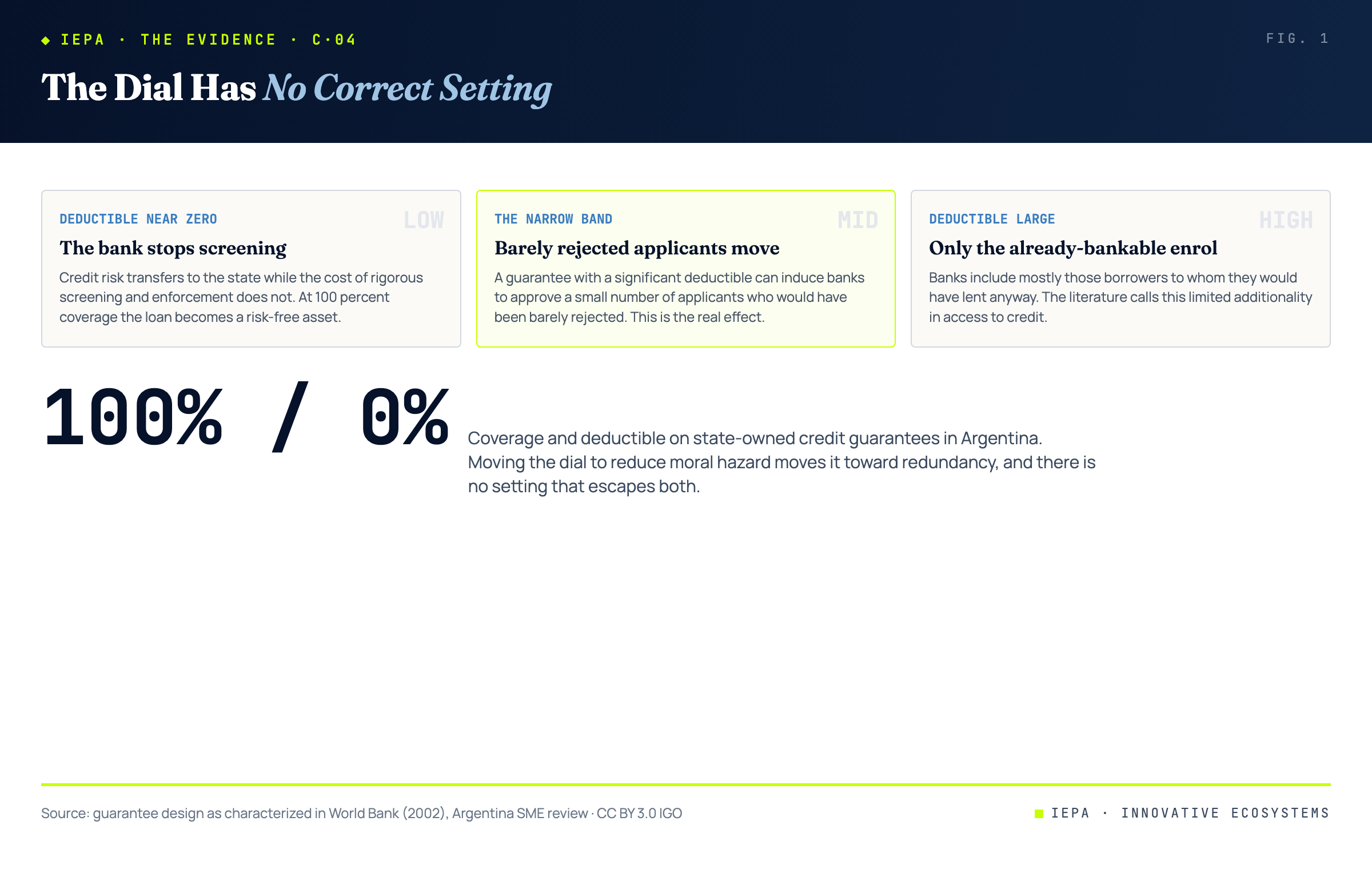
Reduce the bank's risk enough to change its decision and you have also reduced its reason to decide carefully. That is the same adjustment, not two.
02Additionality, Again
Readers of the first piece in this series will recognize the shape. The finding on tax incentives was that most of the money went to investors who had already decided. The finding on credit guarantees is the same finding in a different instrument: after reviewing evaluations of guarantee schemes for small enterprises across developing countries, the literature concluded that these elements imply limited additionality in terms of access to credit.
That recurrence is worth pausing on, because it suggests the problem is not specific to any one tool. Both instruments work by improving the terms of a transaction. Neither can observe whether the transaction was going to happen anyway. Any instrument built that way will pay out on inframarginal cases unless someone deliberately constructs a way to identify the margin, and constructing that way is harder than running the program.
03The Underlying Problem Is Information
It is worth being precise about what a guarantee is treating. Information asymmetry between lender and borrower produces moral hazard and adverse selection, and the asymmetry is unusually severe for small firms. Their defining characteristic is informational opacity: many of the smallest firms have no audited financial statements a bank can use, and some maintain parallel books to work around regulation, which renders the available accounts unreliable even when they exist.
A guarantee does not reduce that opacity. It reallocates the consequences of it. The bank still cannot tell the good borrower from the bad one; the state has simply agreed to absorb part of the cost of guessing wrong. Instruments that attack the opacity directly, credit bureaus, movable collateral registries, audited accounting standards for smaller firms, are slower, less announceable, and address the thing that is actually binding. The guarantee is faster and treats the symptom, which is a large part of why it is more common.
04What the Instrument Can Do
None of this makes guarantees useless, and the literature does not say so. It says the realistic yield is narrow and specific: at most, a credit guarantee with a significant deductible may induce banks to approve a small number of applicants who would have been barely rejected without it. That is a genuine effect on a genuine margin. It is simply much smaller than the ambition usually attached to the instrument, and it only exists at deductible levels high enough that the political appeal of the scheme diminishes.
Which means the question to ask of any guarantee scheme is not how many loans it enabled. It is how many of those loans would not otherwise have been made, and whether anyone has tried to find out. A scheme reporting its portfolio size is reporting the wrong number, in the same way that an incentive regime reporting attracted investment is reporting the wrong number. Both are counting the transaction rather than the difference the instrument made to it.
05The Record Since
The synthesis above is from 2002 and draws on evaluations reaching back to 1987. Two decades later the picture has been refined rather than reversed. A 2021 review of Vietnam's science, technology and innovation spending records that the evidence for additionality of credit guarantees for innovation is limited, which is the same conclusion, and then adds the qualification that matters: results from implementation suggest the instrument can lead to tangible results, particularly for small firms with insufficient or intangible assets as collateral that remain credit constrained.
That is the narrow band described earlier, located precisely. A firm whose assets are intangible cannot pledge them, so the bank's refusal is not a judgment about the business but a limitation of what collateral can represent. This is exactly where a guarantee is doing something a market cannot do for itself, rather than paying for lending that would have happened.
The same review points at the design response. Korea's technology credit guarantee program routes applications through institutions that assess a firm's technology rather than its balance sheet, and issues the guarantee on that assessment. That attacks the informational opacity directly instead of insuring against it. It is a slower and more institutionally demanding answer than a blanket scheme, and it is the direction the evidence has been pointing since the 1980s.
06The Builder's Reading
- Publish the deductible and defend it. It is the single parameter that determines whether the scheme induces moral hazard or pays for lending that would have happened. Full coverage with no deductible is indefensible on this evidence.
- Measure additionality, not portfolio size. The question is what share of guaranteed borrowers would have been funded anyway. If nobody has asked, the scheme's headline number means very little.
- Target the barely rejected. That is where the instrument demonstrably works. It implies knowing where a participating bank's approval threshold actually sits.
- Watch default and recovery, not disbursement. Weakened screening and enforcement show up in recovery rates long before they show up anywhere else.
- Fund the information infrastructure in parallel. Credit bureaus, collateral registries and accounting standards reduce the opacity a guarantee only insures against. They are the slower answer to the same problem.
The wider reading is that a guarantee is a bet about where a bank's judgment is wrong. If the lender is refusing loans it should be making, a partial backstop corrects a genuine market failure. If the lender is refusing loans it should be refusing, the same instrument pays the state's money to make bad lending happen, and pays it again when the loans default. Deciding which situation you are in requires knowing something about the quality of local credit assessment, which is a harder question than how large the scheme should be, and one that scheme design very rarely turns on.
The moral hazard mechanism, the deductible dilemma, the limited-additionality conclusion and the Argentine case of full coverage with no deductible are as characterized in the World Bank's 2002 review of small and medium enterprises in Argentina, which surveys the wider guarantee evaluation literature including Levitsky and Prasad (1987), Meyer and Nagarajan (1996), Mudger (1998) and Llanto and Orbeta (1999). The informational-opacity framing follows Stiglitz and Weiss (1981) and Berger and Udell (1998) as cited in the same source. No IEPA engine outputs are used in this piece.
- World Bank (2002). Argentina: Small and Medium-Sized Enterprises in Argentina, A Potential Engine for Economic Growth and Employment. CC BY 3.0 IGO.
- Stiglitz, J. E. and Weiss, A. (1981). Credit Rationing in Markets with Imperfect Information. American Economic Review, 71(3), 393–410. Cited in World Bank (2002).
- Levitsky, J. and Prasad, R. (1987), Meyer, R. and Nagarajan, G. (1996), Mudger (1998), Llanto, G. and Orbeta, A. (1999). Guarantee scheme evaluations. Pre-digital and grey literature, cited in and verifiable through World Bank (2002).
- Innovative EcoSystems. Seventy Percent Would Have Come Anyway. 2026.
- Innovative EcoSystems. The Entrepreneurship Capacity Gap. 2026.
Counted, Not Working
Mauritania's incubators went from two to nine in five years. Its own diagnostic found exactly one able to raise money for the firms inside it.
→Explore the IEPA
Six zones, every market this research is scored from.
→Open the Atlas
The live global registry this research is drawn from.
→