What Actually Worked
Nine articles of instruments failing. The same record contains the ones that worked, and they have something in common that is not budget, and not ambition.
A series that only catalogues failure is easy to dismiss and not much use to anyone running an agency on Monday. The same body of evidence that produced the failures in this series also contains cases where the instrument did what it was supposed to do. They are worth setting beside each other, because what they share is unexpected: none of them won by spending more or aiming higher.
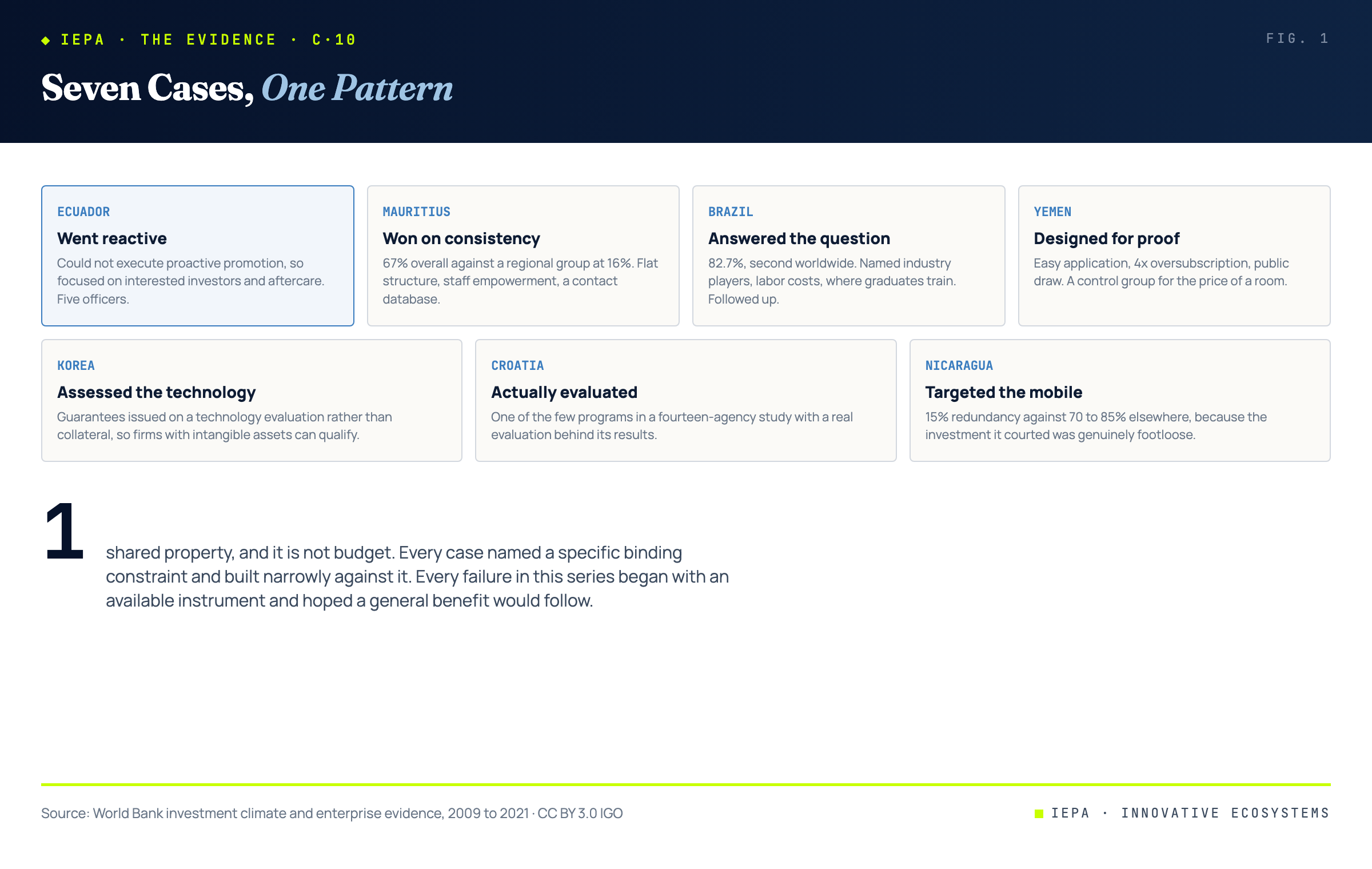
- Ecuador chose to be reactive, and it worked. Facing political instability, a damaged external image and resource limits, its agency abandoned proactive promotion, focused on investors already interested and on aftercare, and staffed the effort with five officers.
- Mauritius won on consistency, not brilliance. The only agency in its region to reach the good performance tier, at 67 percent overall, and the only one to perform well across all three assessments. Its director credits a flat structure and staff empowerment.
- Korea assesses the technology, not the collateral. Its guarantee program routes applications through institutions that evaluate a firm's technology, attacking the information problem rather than insuring against it.
- The common thread is diagnosis. Every case here identified a specific binding constraint and built narrowly for it. None deployed a general instrument and hoped.
There is a failure mode in critical writing where the accumulation of negative findings starts to imply that nothing works, which is both untrue and useless. The record examined in this series contains programs that achieved what they set out to achieve, and they are documented in the same reports as the failures. Read together they suggest something more specific than optimism: the working cases are not the well-funded ones or the ambitious ones. They are the ones that correctly identified what was actually blocking them, and then addressed only that.
01Ecuador Decided to Be Reactive
Ecuador's national promotion agency was created in 1997 with a mandate covering exports and both foreign and local investment. In 2001 it added a department to work on the investment climate and to promote investment proactively in non-oil sectors. Then reality intervened. The country's political instability, the deterioration of its image abroad, and the agency's own resource limitations made conventional proactive promotion implausible.
What the agency's management did next is the interesting part. Rather than continue an approach it could not execute, it developed a deliberate strategy of reactive investment promotion. That strategy had three components: maximize the potential of local investors, respond well to foreign investors who had already shown interest in Ecuador, and support existing investors to encourage reinvestment, which is to say aftercare. Following an assessment of what investors actually needed, a small dedicated unit of five officers was established, reporting directly upward.
Set that against the instruments in the rest of this series and the contrast is stark. No incentive regime, no zone, no marketing campaign. An honest assessment that the conditions for proactive promotion did not exist, followed by a decision to do a narrower thing properly. Most agencies facing the same constraints do the opposite: they keep the ambitious strategy and execute it badly, because the ambitious strategy is easier to defend in a budget meeting.
Ecuador's achievement was not a program. It was the decision to stop attempting something it could not execute and to do a smaller thing well.
02Mauritius Won on Consistency
In the benchmarking assessment covered earlier in this series, where 84 percent of agencies worldwide failed to reach half marks, the Board of Investment of Mauritius was the only agency in its regional group to reach the good performance tier, with an overall score of 67 percent. It was also the only member of that group to perform well across all three assessments conducted. Against a regional group score of 16 percent, it sat close to OECD performance levels.
The report attributes this to consistency and meticulousness rather than to any single strength, and its inquiry-handling numbers show the shape: 75 percent for answer quality and 80 percent for making a strong business case for investing in Mauritius. Asked what accounted for it, the agency's managing director gave an answer with no technology in it at all. The key, he said, is a deep understanding of the business requirements of investors and a listening attitude, and what distinguishes the organization is the quality and dedication of its staff together with a flat structure that emphasizes empowerment of staff and productivity.
There is one system in the account, and it is unglamorous: an investment management information system, including a contact management database covering every contact initiated with a potential investor. The organizing principle behind it is that a customer's needs are met from the moment of first contact through to project realization. That is a customer relationship management discipline, applied to sovereign investment attraction, and it is the sort of thing that shows up in no strategy document because it cannot be announced.
03Five More, Briefly
| Case | What it did | The constraint it identified |
|---|---|---|
| Brazil (APEX) | 82.7% on inquiry handling, second worldwide. Named industry players, labor availability and costs, where graduates are trained. Followed up after replying. | Investors need specific answers, not promotional material |
| Yemen (matching grants) | Easy application, four-times oversubscription, public randomization ceremony. Produced +37.1 points on innovation against a valid control group. | Nobody could tell whether these programs worked |
| Korea (KOTEC) | Guarantees issued on a technology assessment performed by designated institutions, rather than on collateral. | Good firms with intangible assets cannot pledge them |
| Croatia (RAZUM) | One of the few programs in a fourteen-agency study with an actual evaluation. The 2011 assessment found research capacity improved and positive spillovers. | Nobody was measuring effects |
| Nicaragua (incentives) | Redundancy of 15 percent against 70 to 85 percent elsewhere, because its inward investment was genuinely mobile export operations. | Incentives only move footloose capital |
04What They Share
Line the seven up and the common property is not resources. Ecuador acted because it had none. Mauritius is a small island economy. Yemen ran its experiment months before a civil war. What they share is that somebody named the specific thing that was blocking progress, and then built for that thing only.
Korea's guarantee program is the cleanest illustration. The generic problem is that small firms cannot borrow. The generic instrument is a guarantee that absorbs the lender's loss, which as this series has shown either destroys the lender's incentive to screen or ends up covering loans that would have been made anyway. The specific constraint, for a certain class of firm, is narrower: the business is sound but its assets are intangible, so it has nothing to pledge. Korea built an institution that evaluates the technology and issues the guarantee on that basis. Same instrument name, entirely different design, because the diagnosis was one level more precise.
This is the same principle that the fourteen-agency study identified when it listed diagnostic-based interventions among the prerequisites for a functioning innovation agency. It is also, not coincidentally, the logic underneath the index this publication is built on: find what actually binds, and act there. The working cases in this article are that principle applied by practitioners who mostly would not have described it in those terms.
05The Record Since
These cases span 2009 to 2021, and their status in the record is uneven in a way worth naming. Korea's technology guarantee approach is the most recent and appears in current country analysis as a model worth studying. Croatia's evaluation dates from 2011. The Ecuadorean and Mauritian cases were documented in 2009, and we hold no later assessment of either, so what became of them is not something this evidence can answer.
That gap cuts both ways and should be stated as such. It would be convenient to present these as durable success stories, but the same absence of follow-up measurement that this series has criticized elsewhere applies here too. What can be said is what was documented at the time, by an assessment that applied the same method to everyone, and that these approaches were available to every agency assessed alongside them.
06The Builder's Reading
- Name the constraint before naming the instrument. Every working case here started from a specific diagnosis. Every failure in this series started from an available instrument.
- Consider doing less, properly. Ecuador's reactive strategy with five officers outperformed the proactive strategy it could not staff. Retreating to what you can execute is a strategy, not a defeat.
- Consistency beats peak performance. Mauritius led its region by being reliable across every assessment, not by excelling in one. An investor experiences your worst interaction, not your average.
- Aftercare is underrated and cheap. Ecuador built reinvestment support into a three-part strategy. An existing investor is the least expensive investor to win.
- Fix the information problem where you can. Korea's assessment of technology rather than collateral addresses the actual barrier. Guarantees that only shift risk leave the barrier standing.
The uncomfortable implication for anyone holding a budget is that most of what worked in these cases was free. A listening attitude, a flat structure, a decision to answer the question that was asked, a follow-up call, an honest assessment that the ambitious strategy was not executable. None of it appears in a capital plan and none of it can be opened with a ribbon. That may be precisely why the record contains so many zones and so few Ecuadors.
The Ecuador and Mauritius cases are drawn from the 2009 global investment promotion benchmarking assessment, which covered 181 national agencies using a peer-reviewed method. Brazil's inquiry-handling score and Croatia's RAZUM evaluation are from the same and from the 2019 fourteen-agency study respectively. Korea's technology credit guarantee approach is as described in a 2021 review of Vietnam's science, technology and innovation spending. Nicaragua's redundancy ratio is from the investor surveys reported in James (2009). No IEPA engine outputs are used in this piece.
- Multilateral Investment Guarantee Agency (2009). Global Investment Promotion Benchmarking Report. World Bank Group. CC BY 3.0 IGO.
- Kapil, N. and Aridi, A. (2019). Innovation Agencies: Cases from Developing Economies. World Bank. CC BY 3.0 IGO.
- World Bank (2021). Vietnam: Science, Technology and Innovation Public Expenditure Review. CC BY 3.0 IGO.
- McKenzie, D., Assaf, N. and Cusolito, A. P. (2016). The Additionality Impact of a Matching Grant Program for Small Firms: Experimental Evidence from Yemen. World Bank. CC BY 3.0 IGO.
- James, S. (2009). Incentives and Investments. World Bank, Investment Climate Advisory Services. CC BY 3.0 IGO.
- Innovative EcoSystems. Who Promotes the Promoters. 2026.
- Innovative EcoSystems. Ask, or Measure. 2026.
Alignment Is the Hidden Variable
Institutions, incentives, and the quiet coherence that separates converters from theaters.
→Explore the IEPA
Six zones, every market this research is scored from.
→Open the Atlas
The live global registry this research is drawn from.
→